Navigating real estate on Oahu involves more than just evaluating market prices or architectural aesthetics. For homeowners, real estate investors, and developers, understanding local Oahu zoning laws is essential to determining what can—and cannot—be built on a piece of land.
Administered by the Honolulu Department of Planning and Permitting (DPP) under the Land Use Ordinance (LUO), Honolulu property zoning rules dictate maximum height limits, required setbacks, building coverage, and permissible land uses across the island. Whether you are planning to build an Accessory Dwelling Unit (ADU) or looking to maximize long-term resale value, here is how Oahu’s zoning framework impacts your real estate strategy.
1. Key Zoning Classifications on Oahu
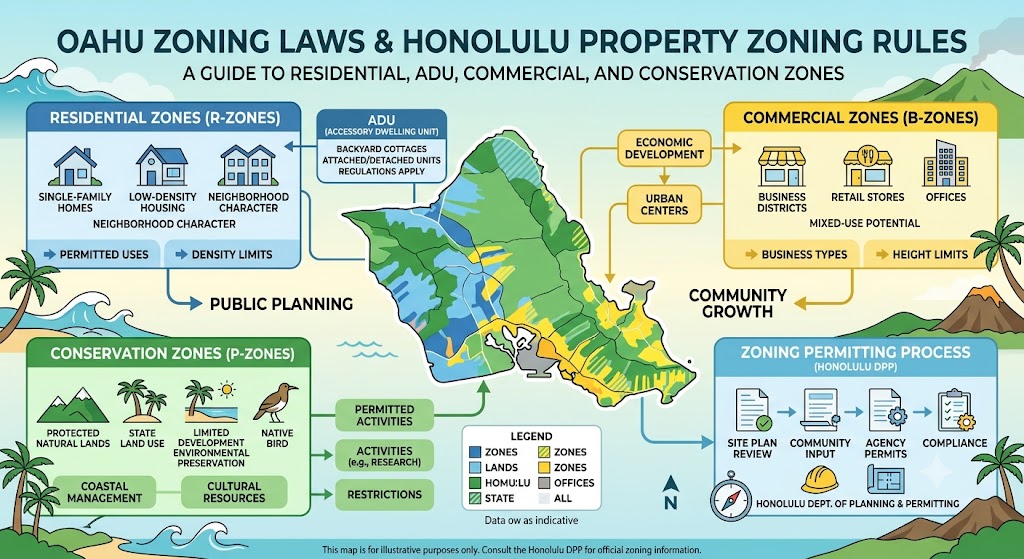
Honolulu divides real estate into several core zoning designations. Each category carries distinct restrictions that directly influence property utility and valuation:
-
Residential Districts (R-3.5, R-5, R-7.5, R-10, R-20):
The number indicates the minimum lot size required per single-family dwelling unit in thousands of square feet (e.g., R-5 requires a minimum of 5,000 sq. ft.). Zoning determines lot coverage limits (typically up to 50% on standard residential lots) and building envelope heights.
-
Apartment & Mixed-Use Districts (A-1, A-2, A-3):
Designed for multi-family residential structures, condominiums, and townhomes. These zones allow higher Floor Area Ratios (FAR) and density.
-
Commercial & Business Districts (B-1, B-2, BMX):
Covering retail, office, and mixed-use commercial properties. BMX (Business Mixed-Use) zones allow vertical integration of commercial spaces on lower levels and residential units above.
-
Agricultural (AG-1, AG-2) & Preservation (P-1, P-2) Districts:
Designed to protect farming, watershed areas, and natural open spaces. Structures in these areas face strict limits regarding footprint size and building use.
2. How Zoning Directly Influences Your Property Value
Zoning regulations establish the ceiling for a property’s maximum potential use, which in turn directly drives valuation.
3. Expanding Your Home: Setbacks, Heights, and ADUs
When planning a home expansion, renovation, or addition on Oahu, several specific zoning rules come into play:
Setback & Height Envelope Requirements
Most residential zones enforce standard setback boundaries—typically 10 to 15 feet from the front boundary and 5 feet from side and rear boundaries. Additionally, residential structures are generally capped at a 30-foot height limit, with specific envelope constraints to protect neighboring views and sunlight exposure.
Building An Accessory Dwelling Unit (ADU)
To address housing supply, Honolulu updated regulations regarding ADUs (second self-contained living units with a kitchen and bathroom). To build an ADU:
-
Your lot must be zoned Residential (R-3.5, R-5, R-7.5, R-10, R-20) or Country District.
-
The minimum lot size requirement is generally 3,500 sq. ft. for a 400 sq. ft. ADU, or 5,000 sq. ft. for up to an 800 sq. ft. ADU.
-
Adequate infrastructure (water supply, sewer capacity, and off-street parking) must be verified by the DPP.
4. Special Overlay Districts: SMA and Historic Zones
Beyond standard zoning categories, properties located in special geographic zones face additional regulatory review tiers:
| Overlay Zone | Scope & Impact | Approval Process |
| Special Management Area (SMA) | Properties located along shoreline zones and coastal areas. | Requires SMA permits to prevent coastal erosion and protect marine environments before construction. |
| Flood & Tsunami Hazard Zones | Properties in low-lying coastal or valley flood plains. | Requires elevated foundations, specialized flood vents, and higher insurance standards. |
| Historic & Special Design Districts | Neighborhoods like Diamond Head, Chinatown, or Hawaiʻi Kai. | Imposes strict design guidelines regarding exterior materials, roof pitches, and architectural styles. |
Key Takeaways
-
Verify Your TMK First: Always look up your property’s Tax Map Key (TMK) on the Honolulu DPP portal to confirm exact zoning rules before planning renovations.
-
Know Your Limits: Check setback boundaries, height envelopes, and lot coverage limits before investing in architectural plans.
-
Consult Local Experts: Partnering with a Hawaii-licensed land-use attorney, architect, or local real estate professional ensures your development plan aligns smoothly with Oahu zoning laws.